
Prompt engineering didn't die. It moved up a layer.
What actually replaces the per-turn prompt in agentic systems — and where the risk goes when no one reviews the wording anymore.
*What actually replaces the per-turn prompt in agentic systems — and where the risk goes when no one reviews the wording anymore.*
Executive summary
The vocabulary of agentic AI — goal setting, guardrails, tool orchestration — describes a real shift, but "prompt engineering is ending" is the wrong headline. The prompt stops being something a user writes every session and becomes something an architect writes once, at deploy time, and governs like a policy document. That relocation also shifts who owns the risk: instead of one bad email caused by a marketing analyst's wording, a misconfigured goal spec or an incomplete guardrail can trigger a hundred autonomous actions before anyone notices. Budget for that governance now, not after the first incident.
The vocabulary is right; the story it tells is off by one layer
A recent Gadget Review piece listed nine terms — agentic AI, AI agents, goal setting, guardrails, values and alignment, tool integration, and the "sense-reason-act-learn" loop — as concepts that replace prompt engineering. The terms are correct. The claim that the prompt simply disappears is not — and getting that wrong is exactly what an architect can't afford.
The traditional prompt is a request-response contract: a human writes text, a model returns text, and the human is the only thing standing between a bad request and a bad outcome. The promise of agentic AI is that the system takes over the whole loop — sensing what changed, deciding what to do, and executing — without someone retyping instructions at every step.
True at the conversation level; false at the system level. Someone still specifies what counts as "done," what the agent is allowed to touch, and what counts as a violation serious enough to stop for — it just happens once, in a configuration, instead of every time someone opens a chat window.
The goal spec is a prompt with a different audience
A goal like "increase brand awareness with a $50,000 budget" doesn't execute itself. It has to become a structured objective — success criteria, time horizon, spending ceiling — that an orchestrator can decompose into a task graph and route to the right tools. Writing that translation well is prompt engineering; it's just aimed at a planner instead of a person, and reviewed on a release cadence instead of per message.
The practical consequence is a real shift in where review effort concentrates. A marketing team that used to route every piece of copy through legal and brand now routes far fewer artifacts through that gate — but each one authorizes far more downstream action. Illustratively: forty campaign prompts reviewed per quarter become four goal specs per quarter, and each of those four controls what used to require forty separate human approvals. Fewer review cycles, more at stake per cycle — a trade that only pays off if the four documents get reviewed with the same rigor the forty used to receive.
Guardrails are enforced per action, not per conversation
This is the mechanism most business coverage of "guardrails" glosses over: a guardrail worth the name isn't a sentence in the system prompt asking for good behavior. It's a *policy engine* sitting between the agent's decision and the tool call that executes it, checking the proposed action against an allow-list, a spending cap, or a regulatory rule before the API call fires. Consider a discount-approval agent: a rule against granting more than 15% without escalation means nothing as a sentence in the model's instructions, because a sufficiently unusual conversation can talk the model into overriding it. The same rule enforced at the point where the payments API rejects any coupon above the cap is a control, not a suggestion — and it's auditable, because every approval and every block leaves a record, regardless of what the model "meant."
That distinction decides the entire blast radius. A poorly written prompt to a chatbot produces a bad output that a human still has to act on. A goal spec with a guardrail gap can authorize a loop of actions before any human sees a single one of them. Whether a pricing error costs one transaction or a thousand depends entirely on which layer holds the constraint — the wording, or the policy engine that checks every call the wording produces.
The "learn" step does more rhetorical work than technical work
The sense-reason-act-learn loop borrows a real pattern — the ReAct architecture, from Yao et al., interleaves reasoning traces with actions so the model can revise its plan mid-task based on what it observes. That's legitimate, and it's why agents recover from a failed API call instead of simply stopping. But "learn," in most systems running in production today, doesn't mean the model updates its own weights. It means an evaluation harness logs outcomes, a human or a scheduled routine compares them against a target metric, and someone edits the goal spec, the toolset, or the guardrail thresholds. The ambiguity matters: "an agent that learns" sounds like something that dispenses with an operating model, while a policy configuration revised every two weeks requires exactly one. Budget for the latter, not the myth of the former.

Figure 1. *The goal spec and the policy engine are the two places where prompt-writing effort actually lands in a production agent — everything past the policy gate is code, not conversation.*
Real-world use case: replenishment at a regional grocery chain
The challenge
Picture a regional chain with 180 stores (illustrative scale) where category buyers ran weekly replenishment for dairy and produce through a spreadsheet and a chat assistant re-instructed SKU by SKU: "restock oat milk for Tuesday's truck, don't blow the budget, don't overorder like last month." Every nuance of the constraint lived in that day's wording. A sick buyer, a rushed prompt before a holiday, or a new hire unfamiliar with the supplier list all produced the same two failures: stockouts on fast-turning SKUs and waste on perishables ordered above what the store could sell.
The approach
Replacing the per-category prompt with a standing goal spec — "maintain 98% shelf availability for dairy while keeping expiration loss below 4% of category revenue" (illustrative target) — pulls the constraint out of daily wording and puts it into a document reviewed monthly by the category director. An orchestrator translates that objective into store-by-store replenishment proposals; a policy engine checks every proposed order against the budget ceiling and the approved supplier list before it reaches the ERP's ordering API. Whatever exceeds the per-order threshold — a spike coming from a promotional forecast, say — doesn't fire silently. It stops and waits for a human buyer's confirmation.
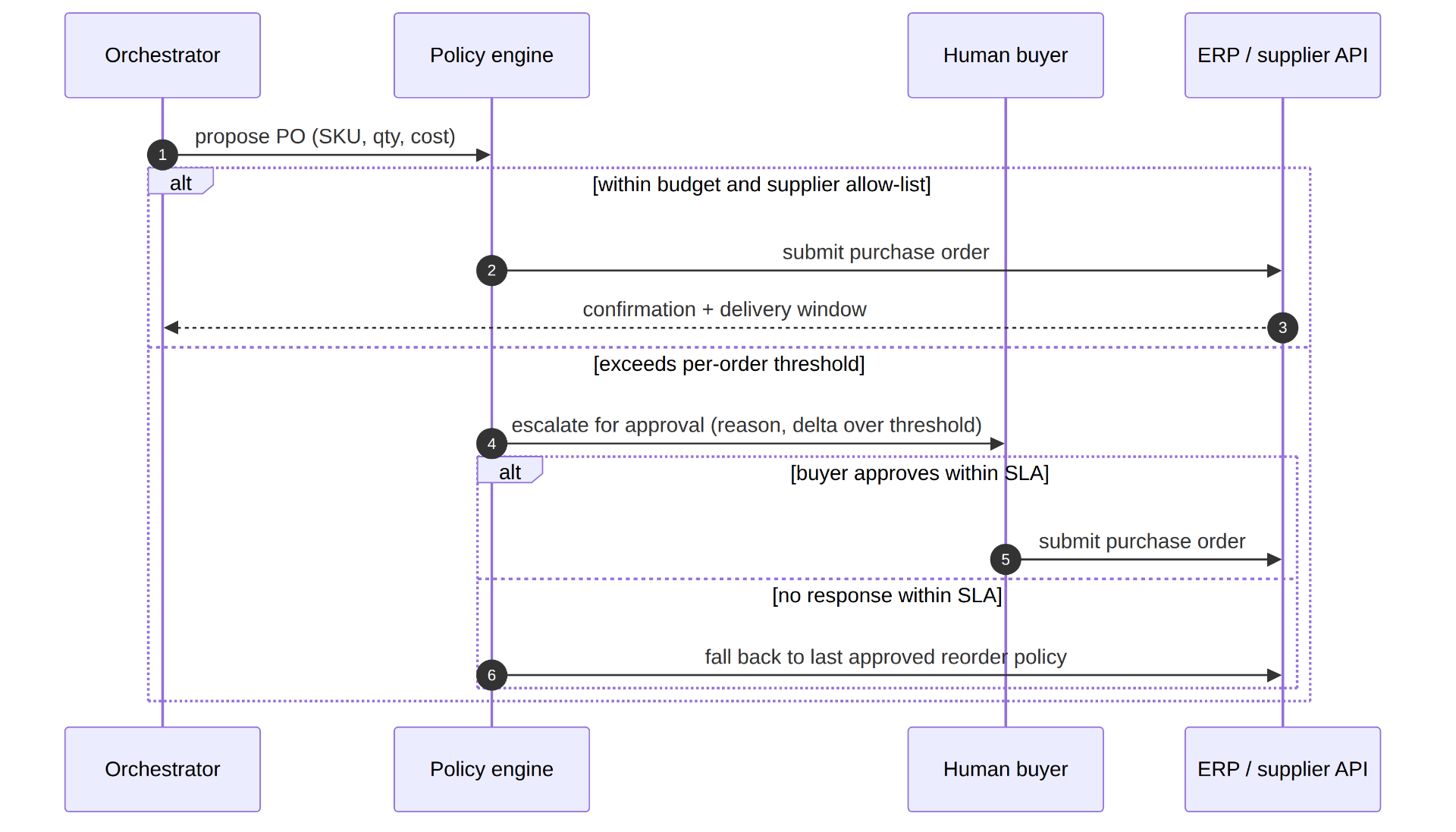
Figure 2. *The failure path that matters isn't the model being wrong — it's a proposal that's technically valid but out of policy, and the system's response is to escalate with a timeout fallback, not to execute silently.*
The result
There is no audited outcome data for this scenario — it's a composite illustration, not a customer case. Directionally, chains that move from ad hoc replenishment to policy-bounded automation report fewer stockouts and fewer write-offs, because the constraint that used to depend on a buyer remembering now runs on every order. The honest claim isn't a percentage; it's that the failure mode shifts from "someone forgot a constraint" to "the constraint was miscalibrated and no one reviewed it on time" — a governance problem, not a memory problem.
Deployment strategy
- 1.Write the goal spec first. *(owner: category/product lead · ~2 weeks)* — Success metric, budget ceiling, and explicit "stop and ask" conditions, in plain language, before any tool integration. Can't state the stop conditions? You're not ready to grant tool access.
- 2.Build the policy engine before the orchestrator gets real tool access. *(owner: platform/security engineering · ~3–4 weeks)* — Every tool call passes through a check that can say no regardless of the model's confidence. Log every approval and every block.
- 3.Run in shadow mode before granting write access. *(owner: data/ML engineering · ~2–3 weeks)* — The agent proposes actions; a human executes them manually. This is where you find out whether the goal spec captures what the old prompts carried informally.
- 4.Set the review cadence before calling anything "learning." *(owner: whoever is accountable for the metric in step 1)* — Decide who reviews the evaluation dashboard and how often the goal spec, guardrails, or toolset get revised. That's the "learn" step — a calendar commitment, not a model capability.
Where the risk lives: the most common failure isn't a rogue agent — it's a policy engine with a gap nobody noticed because the goal spec never enumerated the edge case. A guardrail list written once at launch and never revisited degrades like an unpatched firewall rule: silently, until the one time it matters.
The value proposition
On the time side: moving constraint changes to a monthly policy review, instead of re-instructing every day, frees the category team for exception handling and supplier negotiation — the judgment work a policy engine doesn't do. On the risk side: bounding every tool call at the policy layer, instead of relying on wording, limits the exposure of a bad decision to one logged action, instead of an unbounded sequence nobody reviewed until the invoice arrived. The honest cost: this requires permanent investment in a policy engine, an evaluation harness, and a named reviewer — governance some organizations used to get for free because a human sat in the loop on every output.
Call to action
Before adopting an agent framework, write the goal spec and the "stop and ask" list — hold both to the same review rigor as a production API contract.
Choosing the framework is the easy decision. The hard one is what you're willing to let an agent decide without supervision, and that answer belongs in a document someone signs off on, not in wording that seemed reasonable at 4pm on a Friday.
Sources and notes
- Original source: 9 Agentic AI Terms That Replace Prompt Engineering, Gadget Review, August 4, 2026.
- Yao et al., ReAct: Synergizing Reasoning and Acting in Language Models, ICLR 2023 — the interleaved reasoning-and-acting pattern behind most "sense-reason-act" loops.
- Context on the architectural distinction between workflow and agent: Anthropic, Building Effective Agents.
- *All figures in the replenishment case (store count, availability target, loss threshold, review cadence, dollar amounts) are illustrative compositions, not a reported customer outcome.*
- The figures are original diagrams created for this article.